Posting this a little late because it’s been a long day.
But luckily, today’s first action item was the Census, which I did already early this year. It’s important that everyone be counted! Especially people rather than citizens.
Today’s second action item was registering to vote, which I’ve done. I actually have my ballot for the Democratic primary next to me, because I registered for vote by mail for the rest of the year. This year in particular, it’s important to know your options – particularly that you can vote early at – well, when I did it in 2008 it was at the municipal building. There are voting options that do not involve waiting at a crowded polling place on election day or relying on an increasingly undercut and sabotaged USPS.
The rest of the action items:
Research candidates; check online to see who’s on your ballot this year. Get involved with Voter Registration in Delaware. You can register people to vote by emailing Dubard McGriff with the ACLU DE @ Dubard McGriff dmcgriff@aclu-de.org who have a goal of registering 400 Delawareans in Wilmington by October 10th, NAACP Central Branch by e-mailing, Gerald Rocha Sr. glrocha1906@gmail.com, or contact the League of Women Voters to get more involved.
Sadly researching my candidates and actually filling in my vote by mail is still pending.
Today’s reading was about the different levels on which racism can manifest. The most easily recognizable is usually interpersonal, but structural and institutional racism are both really important. The article talks about understanding historical context as part of understanding the whole picture.
It’s definitely something that comes up in disaster science, because of the environmental racism component, which is both structural and institutional. A finding that will probably stick with me forever is that race is the single most significant indicator of whether you’ll live near toxic waste. Politicians and corporations deliberately sited toxic waste dumps near communities of color, and also, historically, the more outrageous forms of redlining stuck POC near or on land that was “undesirable” – sometimes for being real close to toxic waste. We’re also coming up on the 15th anniversary of Katrina, so take a shot for every time you’ve read something that implied that Black people lived in flood-prone areas on purpose and knowing the risks. And that’s not talking about Isle de Jean Charles and the fact that Louisiana’s firstclimate change refugees are such in part because the Army Corps of Engineers excluded them from historic flooding and erosion protections.
. . . actually, in this context, let’s talk about Isle de Jean Charles at least in order to clarify that the community who was there was not white. A First Nation without federally recognized status (and thus protections and negotiation status), some members of the community have drawn sharp parallels to the Trail of Tears – the one that sparked the settlement of Isle de Jean Charles in the first place. There are complications now with how the community will relocate, and who and where and by what mechanism and when, and that’s what gets discussed more. But I think the baseline, the one that’s worth reflecting on right now, is that ACE deliberately excluded them as not worth protecting way back in the 1950s. Which is racist.
And this week we’re beyond self-reflection and have action items, which I think is cool. Today’s action item was finding your legislators and following them. I already follow my federal representatives on Twitter, and I’d emailed my state senator, but I went and followed him, too, and found my rep and followed him.
For today’s Racial Equity Challenge, one of the three options was watching the below video:
The blurb was:
Watch an interview with Resmaa Menakem, on his book My Grandmother’s Hands, Racialized Trauma and the Pathway to Mending Our Hearts and Bodies. This is the first self-discovery book to examine white body supremacy in America from the perspective of trauma and body-centered psychology.
Which meant of course I had to watch it. Because this is going on my public/professional blog, some context to that: I have probably-PTSD (on top of other brain problems, my brain is an adventure), and I help moderate an online mental health forum with a couple thousand users. One of the books that gets mentioned a lot is The Body Keeps The Score by Bessel Van Der Kolk, so that’s my familiarity with trauma and body-centered psychology.
And, additionally, from talking to a fair number of people with PTSD, I’m familiar with one of the really under-discussed aspects of PTSD: digestive problems. Sometimes formally diagnosed as IBS, sometimes more intermittent and manifesting as “Well, the good news is it’s not organ failure” when someone shows up at Urgent Care/Emergency Room/Campus Health Center with what gets eventually diagnosed as stress-induced gastritis, food poisoning, or an eloquent shrug and a discharge (sometimes with saltines and apple sauce (the health center people were really nice)).
At this point of the pandemic and working with FEMA data and trying to do work towards my dissertation and other grad school stuff, I’m now –
Well, I know enough of what’s going on that I shouldn’t need to go to the ER again, and this video was definitely an intriguing prospect. In an example of the kind of blindness that white privilege affords even the well-meaning, I’d never thought of the impacts of institutional trauma on bodies. One of the other challenges for today was this article on how racism can cause PTSD.
Menakem discusses Black bodies, white bodies, and “blue” bodies – the impacts of institutional racism on police officers – and how everyone needs to find a way to work through their trauma.
I don’t have many other thoughts on today’s challenge, other than a vague sense of injustice that froyo is a stereotypically white people thing. It’s got probiotics in. Those are important, when you’re dealing with trauma’s effects on the body, and so froyo would do more good for the people experiencing more trauma from racism.
Today’s challenge was worded politely, but it’s 100% about white fragility. Because we do that whole thing. Particularly white women, moving the conversation to be about sexism. So I as a white woman feel a bit awkward about it!
But it’s important to sit with my awkwardness. That’s one of the things I’ve internalized in trying to work against and through my own white fragility as I’ve grown as a person. I still have kneejerk reactions to race conversations sometimes, but I can usually manage to catch that reaction, and acknowledge the feeling and see whether it’s something I actually want to act on. And working on this, on trying to separate feelings from speech and actions, has helped me figure out why I have these feelings and if I think the reason is stupid enough end up not having them at all – or only very mildly – when they would be inspired by a conversation.
This has led to the very strange circumstance where racially charged conversations are one of the few circumstances where I actually can refrain from running my mouth. Most of the time. It’s a work in progress, as we are all works in progress.
There was also an accompanying quiz for one of the challenge items, and I am perpetually a sucker for quizzes. I took it on my phone while waiting for my tea to steep, so no screenshot today, but I scored under 10, which comes out to ‘not as full of white fragility as you could be, go read the book to work on it.’ [sidebar: while trying to find a non-Amazon link to the book I found this fascinating article by John McWhorter in the Atlantic about it]
Actually, never mind, no longer a sidebar, because one of the other challenges for today was a list of 28 ways to be racist that I guess comes from the book.
The White Knight or White Missionary. “We (white people) know just where to build your new community center.” Or “Your young people (read youth of color) would be better served by traveling to our suburban training center.” Or “We (white people) organized a used clothing drive for you; where do you want us to put the clothes?” REALITY CHECK + CONSEQUENCE: It is a racist, paternalistic assumption that well meaning white people know what’s best for people of color. Decision, by white people, are made on behalf of people of color, as though they were incapable of making their own. This is another version of “blame the victim” and white is right. It places the problems at the feet of people of color and the only “appropriate” solutions with white people. Once more the power of self-determination is taken away from people of color. Regardless of motive, it is still about white control.
And this is one of the places where I do get hung up. Because I’m genuinely an expert in some things, and working on both deepening and widening this. If I were unilaterally declared Dictator of Houston Zoning (please someone make me Dictator of Houston Zoning), I’d very quickly be making maps of places where people couldn’t live or companies had to stop dumping or . . . Anyway, the point is that I have immediate and drastic plans for if I ever suddenly, magically, have enforceable authority over the city of Houston. Houston gets picked on specifically because it has absolutely no zoning laws as is.
And that would be based on expertise and flood maps. But I’m still white, and a fair chunk of the population of Houston is still Black. So that’s an uneasy scenario because of that dynamic. But the water doesn’t care.
And I think that’s the gist of it, being in disasters. You can try to build back better in a more equitable way, you can try to structure relief so it doesn’t perpetuate racist systems, but the hazard is colorblind. The systems we have put more POC in the paths of hazards, which is terrible, but “hello you are going to be underwater next week and can’t live here anymore, here’s some cash” is something that probably needs to be said anyway.
One of today’s challenges was a Buzzfeed quiz on privilege.
You live with 37 out of 100 points of privilege.
You’re not privileged at all. You grew up with an intersectional, complicated identity, and life never let you forget it. You’ve had your fair share of struggles, and you’ve worked hard to overcome them. We do not live in an ideal world and you had to learn that the hard way. It is not your responsibility to educate those with more advantages than you, but if you decide you want to, go ahead and send them this quiz. Hopefully it will help.
Which I think is wildly simplistic, because intersectionality is a thing. Me being white has had a lot more influence, I think, than my depression, or sexuality, because a lot of stuff is something you can choose to disclose. Skin color isn’t something you can choose not to disclose in a face to face setting.
Today in the Racial Equity challenge we’re looking at implicit bias, including a clip from the Van Jones show.
I’m always a little concerned about implicit bias, because I don’t like not knowing what my brain is doing. I know I use heuristics a fair amount, and on purpose, but the goal of that is to just do things faster, and I want to not recapitulate broader societal nonsense within my own heuristics. Like, the goal is to be Will Smith, not another white woman calling the cops.
The goal is always to be Will Smith, tbh
Part of today’s assignment was to do an Implicit Association Test. I did, as you can probably gather, a Skin Tone Association test. I’m a little uncomfortable with having any preference at all, because terrible parts of my brain still believe that it’s possible to be a creature of pure Reason. I’m cautiously pleased that I’m at least more likely to extend benefit of the doubt to people who are more at risk if cops are called.
I’m participating in the Delaware 21 Day Racial Equity Challenge, so I’ll be posting probably the next 21 weekdays about this. I’d like to be a better anti-racist and ally to my BIPOC colleagues, and this seems like a constructive step.
Today’s questions:
When did you first become aware of your racial identity?
What messages did you learn about race from your school and family?
Did those messages align with what you’ve seen in your life?
When has how others perceived your racial identity affected how they treat you?
I’m white, so I had the privilege of not developing much of a racial identity until late in high school. I just didn’t really think about it. I grew up in a very white town in Canada. I spent some time with local First Nations elders growing up, because my mom worked on a Masters of First Nations Studies and wrote a book on some of the local cultures and intersections thereof.
I remember thinking vaguely that it was racist that all the Chinese people in Barkerville, the Gold Rush historic site near where I grew up, were forced to live in Chinatown because everyone else was racist, but I didn’t think about it in context of “everyone else” being white, or white like me. I remember when my great-uncle died when I was 7 or 8 that I was surprised that the man who eulogized him, who’d been his best friend for years, was Chinese. I don’t remember if I had a feeling other than surprise about it, but I think I probably had some racist expectations that people were mostly friends with people who looked like them, despite multiple cousins who were Métis.
This was despite my immediate family being fairly firm that you treat people as people, you treat individuals with respect, and their stories/backgrounds/identities as valuable. My mother tends to approach life as an ambulatory set of eyeballs with unfortunately high-maintenance scaffolding, but she – and my dad, and my stepmom – trained as a journalist, so you respect (and extract, and document) people’s stories. But that approach also tends to elide reflection on your own race. My dad told me about how the majority-black Bay Area blues community was incredibly important to him as a community and emotional support after the messy divorce that meant he had to leave Canada and didn’t get to see his kid. But, for obvious reasons, that was later.
Moving to the US was different. I think the first time I was really, sharply, aware of race and how it impacted my treatment even in a progressive town, in a high school that “didn’t track” students, was when I took a class called – something like Women and Society? I was taking mostly college-geared classes, AP Statistics and Biotechnology and Shakespeare, and needed my social studies class for my junior or senior year. And the social studies classes weren’t split up like the math classes with their levels or the English classes with their levels of ambition. So I realized, walking into that class the first day, that this was more Black students than I’d seen in any of my classes the entire rest of the year.
And this was late in high school, where we were mostly picking classes based on college prospects and advisor recommendations, and it hit me that this meant that these students weren’t being encouraged to aim for 4-year universities like I was. I was angry.
In general, people tend to treat me well because of my race. I’m also fat, and a woman, so there are complicating factors, but I’m white, and have a white-sounding name. But the worst thing I’ve ever worried about when pulled over by the police is that the driver would get a speeding ticket. For the speeding that they were definitely doing. I think some of my colleagues of color have been slightly wary of me as a potential collaborator or ally or friend because I’m white? But I can’t say that’s not justified, having seen some of how they’re treated, and I don’t know how to alleviate any of that wariness without being weird and pushy in ways that are significantly weirder and pushier than I think anyone would be comfortable with.
This is going to be a structural adventure. All expandable sections should be taken as parentheticals and footnotes that are still conscious of the fact that comments, also, go at the bottom.
I’m currently attending the 45th Annual Natural Hazards Workshop. I attended it in person last year, and it’s virtual this year, and some of the common threads are passionate, involved, and incredibly kind people who are involved in the science and policy of disasters.
More of why it’s important to meIt’s the first place I presented a professional academic poster, and where I’ve met incredibly nice people and been able to talk to them about their ideas and research. It’s also where the DRC’s alumni reunion is, every year, because it’s one of the big conferences for disasters – and one that, by dint of effort, structure, and the strict banning of acronyms, is host to practitioners, policymakers, academics, and the great conversations that can come of them being in the same room. So it’s important to me to attend for several reasons, including the fact that the people I talk to there are almost uniformly incredibly nice and make me feel hopeful about the world.
This isn’t the first virtual conference of the year, and won’t be the last, but it’s the one I’ve most tried to engage in, and so the one that’s inspired this tweet.
I need to find (or write?) a guide to surviving virtual conferences with #adhd. #HazWS is full of the nicest people in the world, with cool and important ideas and research, and I’m really struggling to stay engaged just because of the medium.
The ADHD is newly diagnosed this year, but given that Zoom Fatigue is something growing in people’s awareness, I don’t think even those of use with ADHD are alone in the struggle.
ADHD is an adventure, y’all
I was initially screened in third grade, when I would finish my tests in class and then talk to people and be helpful and generally be cheerfully and politely disruptive. The psychiatrist, on rotation in my small Central British Columbia town, decided I didn’t have it.
I got through high school with okay grades and weird coping mechanisms (to be enumerated later), flunked out of college the first time because of untreated depression, got my shit together to the tune of running my own business and training as a paramedic, finished an undergraduate degree, finished a Masters degree, went in to see a psychiatric nurse to have a prescriber for my continued use of antidepressants, and 5 minutes into our consultation she just kind of cocked her head to the side and then pulled out an ADHD assessment.
Turns out, at 30 years old, I have moderate inattentive-type ADHD. I sometimes have imposter syndrome about that! Because my roommates have ADHD, too, but it manifests differently. In high school, I most of the time had two part time jobs, multiple clubs, an active social life, and an online writing group. The month I did Emergency Medical Responder Training I also worked solid weekends, studied, and finalized the bi-annual launch of a literary magazine. I did my makeup for the launch I was MCing on the bus to the location after work. I’ve had people who genuinely like me describe me as, variously, a shark, a whirlwind, and a hurricane.
I’m still working out how much of that is my personality and how much of it is literal decades of overscheduling as an ADHD coping mechanism. I also realized that the whole thing where I keep my laptop with me at pretty much all times is also a coping mechanism. I realized this in the middle of, during some tech issues that meant I was in class without my laptop, going on a 10 minute rant about the way Calvinism had contributed to problems with the National Flood Insurance Program. Sorry, Dr. Kendra, and I hope at least it was amusing.
. . . mostly I don’t have imposter syndrome that much anymore.
So, during this lunch break, some recommendations, tactics, and coping mechanisms for getting the most out of virtual conferences.
Thrivewithadd.com has this guide on survival tactics for Zoom meetings generally, but meetings and conferences aren’t quite the same beast: this workshop can’t really be an email. Additionally, it doesn’t matter as much whether you as a participant are dressed professionally: if you’re in the audience, you don’t have video on most of the time, and if you don’t want to turn it on at all you can ask any questions you have in chat.
Dr. Jenn Trivedi suggested taking notes by hand.
Not sure if this would help at all, but I've been taking notes by hand. It's been helping me stay more focused on the Zoom calls and helps me not be just staring at a screen 100%.
— Dr. Jennifer Trivedi (@JenniferTrivedi) July 14, 2020
I’ve successfully embroidered through one conference (I had a little belt bag with my embroidery kit, it was badass and a great conversation starter), and knit sometimes at conventions. Having my hands busy definitely helps!
But I also run into trouble with ‘Oh, they’re messing with PowerPoint, I’ll just check my email real quick,’ and next thing I know I’m resurfacing because someone’s voice just called for one last question. Which is suboptimal.
One answer would be splitscreening, ideally with the conference on the main monitor and whatever else on a secondary monitor, but that still leaves the problem of my primary attention just. Wandering off. There is also the issue of I am on my laptop on the couch, and do not have a secondary monitor handy.
So! An itemized list of things I’m going to be trying once lunch ends, some of them based on evidence or prior suggestions.
Why did I end up sticking with this particular naming scheme? No idea. But I guess I’m rolling with it.
Classes started up again this week. It’s nice to have structure, even though I’m a bit overwhelmed by all of the Zoom calls. I’ve stopped going to some of the professional development calls, because it’s just . . .
I’m an extravert. I like working from the office because there are people to chat and I run into people at the Keurig and we can keep up with each other. I live with other people – more people than I ever have before, right now, but I’m deeply uncomfortable living alone. I like being around other people. But wow this is so many Zoom calls, this is kind of too many people. It’s like a high-volume meeting day except every day. The only upside* is that I can do so from the comfort of my own home.
But the sheer volume of contact means that I’m finding it incredibly relaxing that Tristan and Alexis are currently on Flour Quest.
Maybe I should back up. Today Tristan and I needed to go pick up prescriptions at Walgreens.
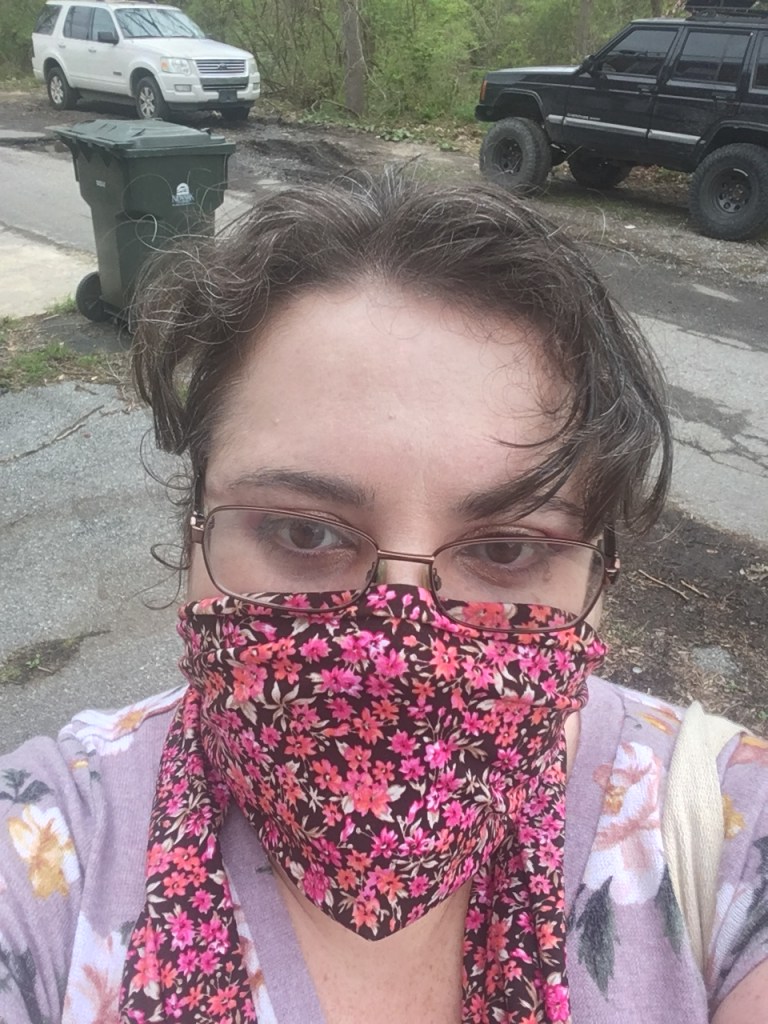
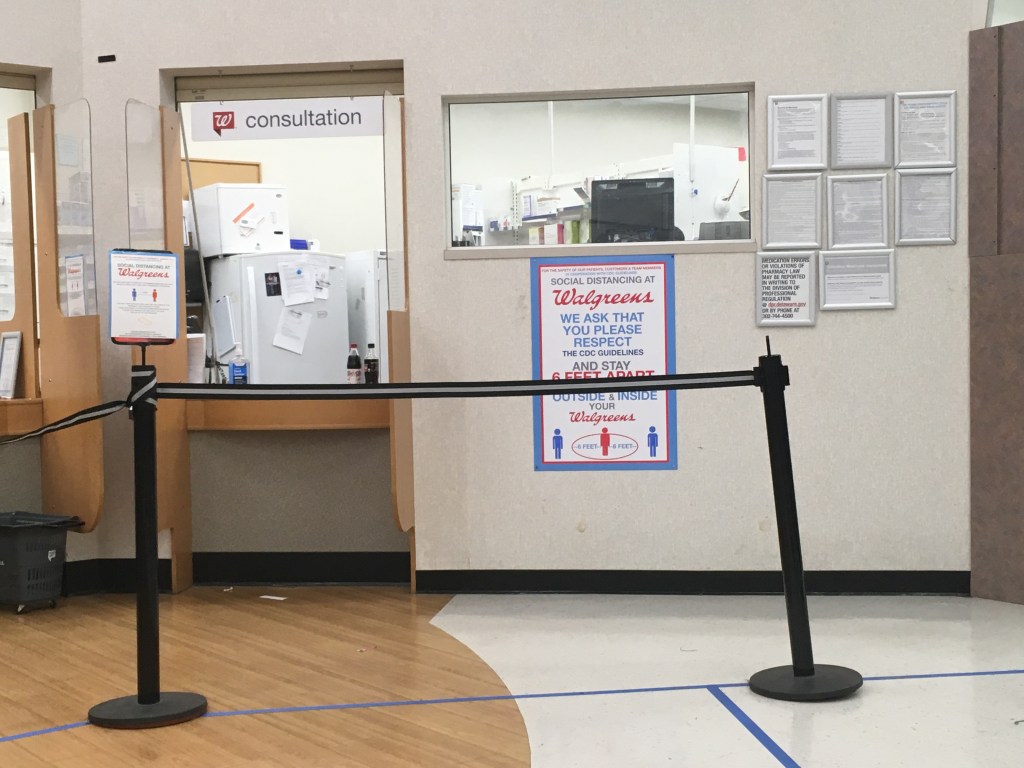
I wore a scarf over my face for part of it, because that’s following CDC guidelines. Tristan didn’t. The Carrs, when they went to pick up our CSA share, also didn’t. Which makes it feel a little pointless: a household is as susceptible as the least cautious member. But I wasn’t the only person in Walgreens with a mask: they’re apparently becoming more normal. And they had safe distance slots for queueing marked in tape on the floor, as you can see above.
But we still needed to actually go, because controlled substances such as a couple of our prescriptions cannot be sent via mail. This seems generally problematic, because immune compromised people can still need medications that you currently need an ID to pick up. Hopefully we’re not all going to be sheltering in place for much longer, but I do think that it’s something policy would do well to address.
So we went to pick stuff up, and got Subway while we were out: ordered online, then only me going into the store, staying as far as possible from the only other customer there, who was in as representative of his family, with two kids waiting in a truck outside.
When we got home, Alexis and I got talking about bread. Our CSA share, we get bread as an add-on, but I think we’ve also both been seeing everyone making their own bread on social media. Alexis has sourdough starter on the stove: I hadn’t noticed it before. But it should be ready by midweek, which is when we’ll probably be out of our other bread. And I’ve been wanting to make bread, though I’m nervous as I don’t think I’ve made yeasted anything before. So we talked a little about that, and then came to the realization: we’d go through flour really fast if we started making bread, and there have been shortages. King Arthur Flour, which is what Alexis really likes, is several weeks backordered on most of their more popular flours. I went through their website as Alexis went through grocery websites, seeing where we could get flours. But King Arthur is down to just flours that aren’t suitable for most breads, because we are far from original in this idea.
I think it’s really worth noting that a lot of shortages right now aren’t due to panic or mismanagement: they’re because people are at home. There’s a great article on Medium talking about the fact that commercial toilet paper is not what’s selling out now. Likewise, people suddenly eating lunches at home (for themselves or for kids who normally eat at a cafeteria) are using a lot more bread in sandwiches, and people with a lot of free time and energy and boredom are looking at shelves that are light on bread and deciding to make their own. People are, in many cases, more bored than worried. And bread is an ideal antidote for people working from home in that it is a staple that takes a lot of hours where you need to be nearby but not necessarily paying a lot of attention. Also you can Instagram it.
Alexis doesn’t care about Instagram, but she does care about bread. So she and Tristan (because Alexis doesn’t drive) hit on the idea of going to the local Asian grocery, as we’ve both heard about them generally being better stocked right now. The plan was, if flour couldn’t be found in the grocery store a mile away, they’d head across town to the Asian grocery, and pick up flour and maybe more Lysol wipes so we can sanitize stuff that comes into the house more thoroughly.
So it was very quiet for a while.
But now they have returned, triumphant, and later this week we should have sourdough.
*This is a lie: another upside is that no one can see when I’m playing games on my tablet the whole meeting.
I’ve been spending a fair amount of time on social media recently – as, I think, have we all – and I’ve noticed a lot of family-oriented posts from my colleagues with family. Which makes sense: family is important.
But I’m also thinking about how family is going to make a difference in what everyone can produce right now.
I’m a disaster scientist: this means that not only am I expected to do the general academic productivity thing, but that right now, while we’re all in quarantine, might be one of the defining moments of the careers of every cohort with me in the Disaster Research Center. The ability to engage with research right now is going to be massively important. But it’s going to vary, for a lot of reasons that have nothing to do with dedication or interest.
So first, a preview of the way my life is regularly organized, with the help of my roommates and adviser:
I live with several people. Sometimes this bugs me, because I’m an only child and apparently that never goes away, but it means that my bills are low because they’re shared.
I have an involved adviser, which makes everything about my academic career more straightforward and less nervewracking
I have guaranteed funding
My adviser is mostly retired, and my funding comes from an outside grant: office politics are utterly irrelevant to my life if I want them to be
I live about a mile from campus, near a shuttle route: commuting under regular circumstances is a non-issue
Not just that, Tristan drops me off in the mornings
Tristan does the laundry. All of it. Every Sunday they’re in town. It’s predictable and I don’t have to think about it ever.
Alexis does most of the grocery shopping
Alexis also does most of the cooking
Tristan and Alexis are both brilliant and writers and willing to read my essays and give feedback really quickly
Duncan keeps the kitchen clean and cleans the living room once a week
The cats and bearded dragons technically belong to the Carrs, so they do all the animal care except when I refill their water fountain
I’m not saying this to brag, though I know it can come off that way: my life is pretty much optimally structured for me to do well academically. That’s on purpose! My brain is sometimes extremely terrible (for which I have medication and a full spectrum light), and so for times I have to fight my brain, not having to fight my environment really helps. The tremendous people in my life have entered into a conspiracy of ease.
This means that, during regular times, I’m moderately productive and definitely overinvolved.
During this period of isolation? All of that list is going to matter more. Additionally:
We have a number of computers such that everyone has their own, even with my current technology adventures
There are no children in the house. Children are important, and they’re quite literally the future, but no one has to care for them or look after their health or educate them while school is shut down. This is the biggest gap people have been talking about, that I’ve seen, and no one in this house is engaged in the work and noise of helping the development of a whole person.
Tristan is working the regular amount, because data centers are essential services.
Nick is working more than usual, because Target’s flex crew does online orders. Apparently he’s getting hazard pay and unlimited overtime. So this, too, means both quiet and work orientation in everyone’s attitude.
My contract continues to pay me.
I’ve worked from home before. For years. I’m used to the scheduling and the changes in mindset and the ways I need to orient myself.
My family is all fairly far away and mostly either taken care of or not in a circumstance I can help with anyway.
I spent about 8 hours yesterday coding data for my new Covid-19 related side project. Tristan hung out in my room and wrote and we listened to a podcast, then Tristan helped with preliminary sorting of some of the data when I clutched my face and screamed at the realization that after starting the day at 235 emails and processing 50 or so to end up at 232 emails (I appreciate all the data people are sending me, I just also am slightly overwhelmed).
I know this data, and some of the other stuff I’m working on, are probably going to lead to publications. But I’m also intensely aware of just how much privilege and deliberate ordering of my life and assistance from other people have gone into my ability to be productive. And I firmly believe that people caring for children or family members right now and people dealing with financial or environmental uncertainties due to the various shutdowns shouldn’t face any kind of career slowdown because their circumstances are different and they had other things to do than write. But I don’t know how well the academy will accommodate this.
I hope it does it well. A conspiracy of ease should not be a requirement of academia in general.

 Eileen Young