And a note – one of the nicest things a supervisor ever said to me was noticing that I don’t speak negatively about people. That is broadly true, and especially in a working context. I try to provide praise when relevant, but am used to working with excellent people and keep forgetting to note out loud that it is in fact excellence. I also differentiate between the characteristics of a person and the policies and actions of a corporate or political entity, no matter how closely tied they are. The core of my personal rule, too, is to never say anything about someone that I wouldn’t say directly to their face.
So when I talk about JG here, I am writing of JG Development, the corporate entity making proposals and doing work. I have no idea who is involved in particular actions except for who shows up at meetings, and have no opinions about Jeff Grundahl as a person.
Now to the meat of it: writing about the charm of Mount Horeb, as I started doing from a personal perspective last time. It was suggested that there were really good parameters in the building code, so I ended up reviewing the Zoning Code and the Comprehensive Plan. One upside of currently searching for work: I have bandwidth for close reading of policy documents for fun. The Comprehensive Plan is from 2022, and was amended in 2024, so it’s still pretty current, given that they’re supposed to be good for ten years (though they can be updated or amended as needed).
On Wednesday, our village plan commission had a meeting on, amongst other things, a proposed concept for a new development on Main Street. In advance of the meeting, someone posting one of the design photos on the community Facebook pages, which resulted in not just many comments on the posts but a really tremendous turnout to the meeting itself. I haven’t been attending many of them, even though our municipal building is close and I’m subscribed to their calendar, but this got me to walk over to say my three minutes of comments and also hear out their whole proposal. After, I felt moved to then email the village administrator, who hadn’t been able to attend the meeting. I wanted to then post it in one of the Facebook groups, partly because I think sometimes people don’t have the vocabulary to articulate why they don’t like something about a building, and that’s something I’ve been able to learn something about between a grad class in historic preservation and a crippling HGTV addiction. Anyway! It wasn’t posted in the group and now I’m suspended from posting or commenting in that group for a week. Maxim of charity says that it really was quite a wall of text.
Dear [Administrator],
At the end of the planning meeting on Tuesday, attendees were encouraged to email you with further thoughts on the JG Development concept proposal. I have many thoughts! To preface: I think infill construction in that part of Main Street is a fabulous idea. As the owner of Sugar River Yarns mentioned, accessible retail space there would be not just a general step in the right direction but a specific boon to businesses with client bases with more diverse mobility needs. A Witches Night Out where more attendees can go into every single business would be delightful. Additionally, while I love the trees and shrubs on that lot, it would also be a welcome sight to see more interesting buildings and shops as I come along main street; more of a hint that Main Street is continuous rather than so thoroughly interrupted. Mixed use development such as commercial apartments are an ideal arrangement. In sum: I do not oppose progress generally, and am even in favor of development on those lots specifically. But I think the JG Development concept proposal so thoroughly missed the brief as to make continued work with them a potential waste of everyone’s time.
The things they did well, to give them their due: making it look like multiple different buildings built next to each other is an excellent nod to the composition of the 100 block of East Main Street and the included parking seems nearly sufficient for the majority of the building’s inhabitants at 69 stalls for 66 proposed units.
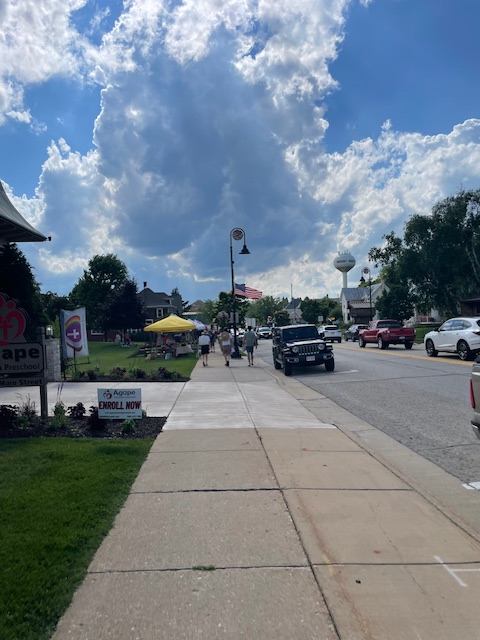
Still, that leaves the rest of the concept. First, JG Development’s concept is four stories, where the limit is three. Even measuring against the Opera House, it is 7 feet too tall. Included please find a picture I took yesterday as I approached the Farmer’s Market. The visuals included in the concept documents do not include context, but imagining a four story building rising from the trees and green, hulking over Sjolinds and dwarfing the Chamber of Commerce building, is frankly horrifying. The proposed prominence is a rudeness.
And that leads neatly to the architecture of the building itself. In their own words (on page 3 of their Letter of Intent), “The goal of the development aesthetic is to compliment the historic Main Street appeal of Mount Horeb, albeit most small towns anywhere.” While it is perhaps overly pedantic to point out that compliment is not the word they meant, the error seems to reflect a deeper truth: that any nods to the appeal of Mount Horeb are lip service and not reflected in substance. And, of course, there is the more obvious slight acknowledging that the developers do not see anything distinctive or worth preserving, furthering, or contributing to in Mount Horeb, anything that could not be found in “most small towns anywhere.”
That goes some way towards explaining why the entire building is thoroughly modern vernacular architecture and any design inspiration seems to have taken form as awkward applique rather than any true homage or harmony. There is nothing inherently wrong with modern vernacular architecture – obviously, or it would not be so widespread – but it is wildly incongruous with downtown Mount Horeb. We have several styles of architecture downtown, but they are notable and distinct styles, none of which include the pilasters in one segment of the proposed building. We have Norwegian architecture, with the focus on natural elements, clean lines, and pitched roofs, as evidenced in the Chamber of Commerce and Skal buildings. The Opera House as well as many other buildings in town are Queen Anne or at least influenced by it, with turrets and multiple styles of siding. A note: turrets are very different from whatever the proposed detail on the fourth floor of the JG concept is. Other buildings on Main Street are also designated as commercial vernacular, but they were vernacular at an earlier period influenced by, amongst other things, Edwardian architectural concepts of symmetry, simplicity of embellishment, and focus on green space. JG Development’s concept seems to have taken the form of reading that other buildings were also vernacular commercial architecture and then proceeding with disregard verging on disdain for the history and fact of that existing architecture. Some herringbone brick inlaid in the facade of the proposed building is like slapping a bumper sticker on a car and declaring that it changes the make. Mount Horeb also has its own distinct style in the Queen Anne buildings with Norwegian rosemaling decor, such as Open House Imports and houses on Main Street. The design reflects none of these things.
Speaking of green space, the proposed development has none. This is not merely an aesthetic concern but one of the livability and walkability of Main Street. Given the humidity of the Midwest in summer, we are already prone to heat islands. The greenery on those two lots right now provides areas of high albedo and better air flow to reduce the buildup of heat. A walk down Main Street at noon demonstrates this effect as well as any citations of the science would: the north side is frequently cooler than the south side along that block despite the lack of shade. A zero lot line building with no greenery or awnings would negate that. Additionally, there is no proposed green space anywhere on the complex, neither rooftop gardens nor any sort of additional trees. While there are trees on the sidewalk that would not be destroyed during the construction, it would still be an overall decrease in greenery. The proposed U-shape of the apartments above additionally will look down on blank concrete above the parking lot. That sounds both deeply unappealing to residents as well as a lost opportunity to include greenery. The greenery would also reduce noise pollution from the inevitable HVAC requirements of new construction for so many new residents.
[Village Treasurer] brought up in the meeting, almost jokingly, the concept of turning the U around so the blank space was at the front, and having greenery there. That would be a possible viable option – as would two stories straight up and then a recessed U facing south, with green space on the roof.
If there is concern on JG Development’s part about having that additional weight above the parking structure, I suggest they can look no farther than Epic in Verona, where JP Cullen constructed an 11,000 person auditorium with no internal columns. If they can do that, JG Development can surely put the bulk of their apartments above parking.
A final aspect is their insistence on a lobby that takes up fully half of the first floor, which is supposed to be, per the brief, commercial space. A lobby is not commercial space. On a functional level, my company’s office lobby in Washington, DC is a hallway with a security guard and an elevator. When I was last there in November, it also had a Christmas tree. No one was confused on how to find their way to the office. Moving their lobby to the second floor, I suggest, would not prevent people from finding it. Additionally, they propose to include resident amenities in that space. At this point, I must apologize, because I fear my uncontrollable scoff at this point may have been caught on the meeting recording. JG Development proposed that their oversized and out of brief lobby include the building workout facility for residents, as if this would be an attractive amenity. Even fitness influencers, who are professionally exhibitionist with their workouts, prefer to be able to control the lighting and angles of their displays. Working out visible to all pedestrian traffic passing on Main Street seems like spectacular shortsightedness about the actual needs of residents in addition to taking away from potential actual commercial space. There are three proposed commercial spaces, and they mentioned offering first pick to existing businesses. Given that there are four businesses in the existing spaces, that is obviously insufficient. The entire concept of the lobby space seems poorly conceived as well as counter to the spirit of the development as commercial apartments.
This difficulty with the concept does seem to reflect that JG Development does not seem to be experienced in mixed use development, with their divisions doing commercial and residential renovation and construction so separated as to operate under wholly separate names.
In summary, JG Development’s intransigence over the massive lobby and four stories suggest they are a poor fit for this project. But assuming their requests for more information as to what they could improve were genuine, I hope some of this feedback at least is congruent with the opinions of the planning committee.
Best,
Eileen Young
View approaching the Farmers Market. Nothing really stands out except the water tower and American flag. The proposed building would block the view of the water tower completely.
I used separators rather than the quote format because it is such a huge swathe of text to read. Other concerns that I didn’t end up including in the letter:
How the small businesses in the current buildings would be able to survive the construction time (though I did bring it up during my comments)
Whether now is a good time to do this given uncertainty about federal tax credits and the economy generally
Whether there are any attempts to make it energy efficient or ‘green’ – this one I think is more a personal than general concern, though I don’t think anyone likes excess strain on the electrical grid when our utility workers are already heroes who go out in severe thunderstorms. I think development should think about the future, that progress should be progressive, and that low carbon footprint energy efficient buildings save on heating and cooling bills and are also cool and attractive places to live that would appeal to more potential tenants
But those, I think, are more about any specific plan, and I wanted to focus on the concept overall. As you can read, I still had a lot to say about that.
This is posted here as a durable record, and as a thing I can link in village Facebook groups and hopefully not exceed post length requirements. If you are not in Mount Horeb, please do not contact any of our village board. Get involved in your own planning process. Make your opinions known and try to argue for the community you live in to continue to be the kind of place you moved to on purpose.
 Eileen Young