The proposed plan I commented on this summer has been revised, and revised again. It now has a fairly united public response, too.
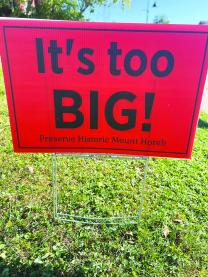
But it’s getting another hearing at the Planning Commission meeting next Wednesday. The Agenda Packet is 260 pages.
The new revised plan is much prettier than the original. The facades will be pleasant to look at from street level and blend well with downtown Mount Horeb. The remaining problems are best summed up by the grassroots campaign against it: it’s simply too big.
But there are important and identifiable components to this: lack of green space, height, and lack of parking.
The lack of green space I addressed in my last open letter as contributing to possible heat islands. It also makes the city less overtly conforming along Main Street with the Tree City USA signs around town. I mean by that both that it will detract from the overall charm that draws tourists and also detract from the perception of values espoused in Mount Horeb, which attracts tourists and shoppers overall. Including a patio for residents is an improvement over complete lack of outdoor space, but is still not green space.
Height is the sticky place: the architects have significantly redesigned, which is fantastic, so there is no longer the horrifying prominence that would dominate downtown. But it’s still too tall. It’s like the Duluth building built by the same developers: on a scale that is aggressively alien to the rest of Mount Horeb. The scale JG Development thinks is appropriate for Mount Horeb does not appear to align with the scale anyone else thinks is appropriate.
Then there is the parking. Everyone is sick of the parking. I don’t even drive. I’m so sick of the parking conversation. I’m also now on the village Green Team, one of the goals of which is more bike friendliness and helping the village be more friendly to a car-free existence. So, to be clear: I am writing my concerns about the parking as a non-driver who will be able to walk to these businesses.
But it’s 68 parking spots for 63 units plus the businesses. That’s 1.08 parking spots per unit. In densely urban areas, that could be not just adequate but generous for business parking. Imagine someone living upstairs from their workplace, or working somewhere else on Main Street. They wouldn’t need a car and would be able to walk everywhere and eat at our great restaurants. And that’s the thing: they’d pretty much always be eating out because grocery shopping by bike mostly sucks, even with as close as Miller’s is to downtown. Nic’s letter in the agenda includes some really relevant wording: the idea of a captive customer base. Because that’s what they’d be. The urban areas where parking ratios like this are generous are not picturesque village downtowns: they’re dense metro areas that have things Mount Horeb simply doesn’t, like public transit and a wide range of delivery options. The concept presented is that tenant parking will be in-building, but the math ain’t mathing.
Which is the colloquial way of saying: the code that the developers themselves quote in their letter requires:
- A minimum of one off-street parking space shall be provided for each bedroom within a commercial apartment.
So, even if we’re not counting studios as having bedrooms, because it’s all one room, leaves us with 13 2 bedroom units and 38 1 bedroom units, for a total of 64 required parking spots. Wow, with that math, their proposed 68 spots actually looks generous.
But the current code minimum is per bedroom with an unwritten addendum of “this is a nice village, so be reasonable,” which gives us 12 studio apartments, 13 2 bedroom apartments, and 38 one bedroom apartments, for 76 minimum parking spaces and a ratio of 1.21. The proposal is for a ratio of 1.08.
Additionally, their letter frames it in a table as dwelling units, when the code is specifically for bedrooms, and the dishonesty is distinctly frustrating. At least they acknowledge later that the reasonable number of parking spaces for their proposed building, if it were anywhere but the downtown area, would be 139. That’s a ratio of 2.21.
And the parking survey addressed non-event days. Which is reasonable except for how hard everyone works on having those event days and attracting people. We invite any out-of-town guests to park in our driveway in the expectation that there will be no parking anywhere else a convenient walking distance from downtown. This could be resolved, potentially, by building a parking garage across the street from the proposed development in the empty lot already owned by JG, which could potentially have an attractive local mural added to the outside, addressing multiple problems at once. Or they could just have fewer units, which would solve more problems.
10 bike parking spaces also seems like a low number when so much is reliant on the ability to attract bike and foot traffic. In fact, if this development were in Madison, 85 bike parking spots would be required. Which is definitely a gap between the proposal and the ideals and development plan the proposal is supposed to conform to.
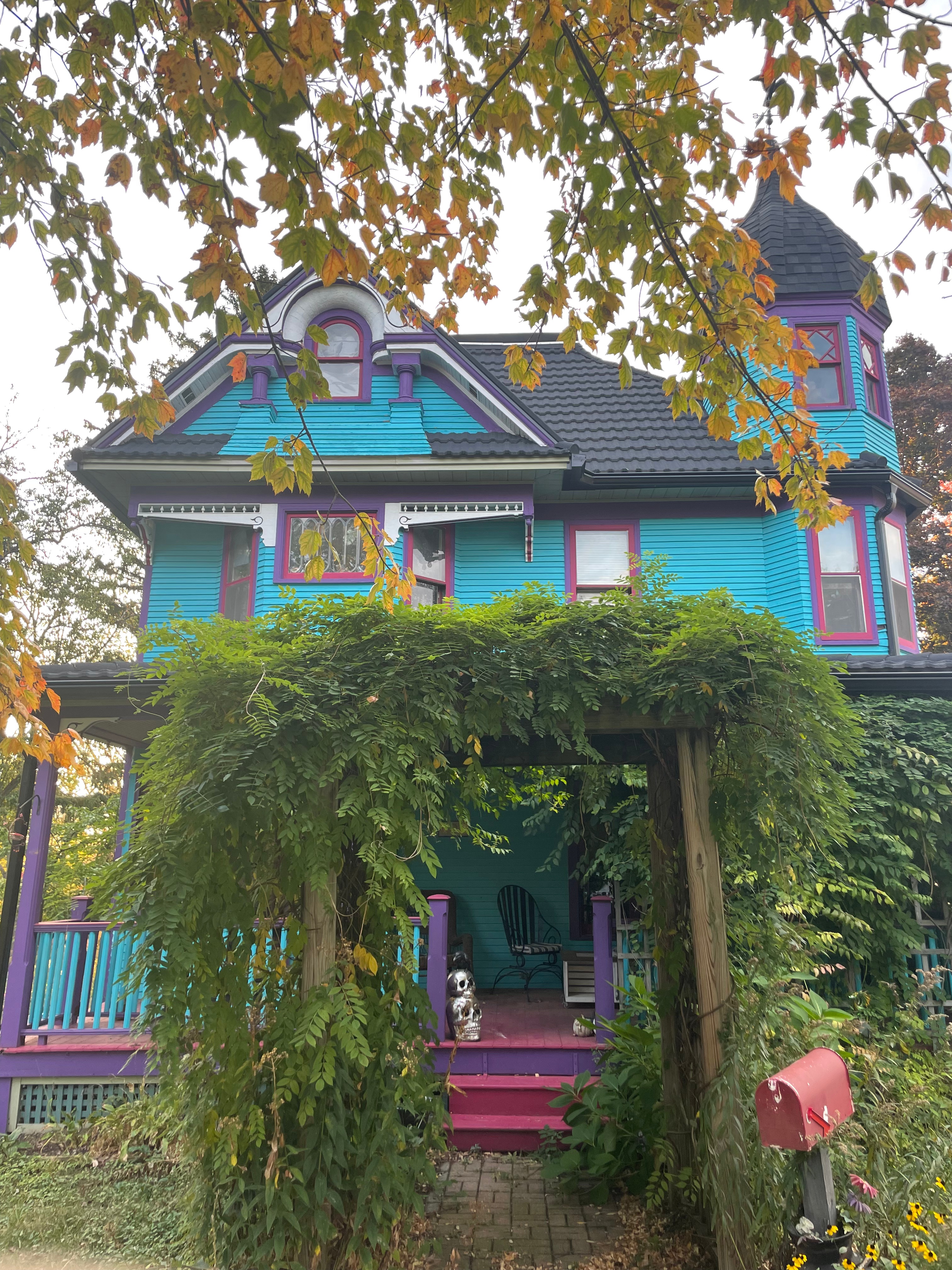
There are additional issues with the way their letter is presented, such as ignoring the complexities of historical designation – my own house is a 1905 traditional Queen Anne style, with colors appropriate to the Painted Lady style of Victorians popular on the West Coast and several original features including many of the windows visible from the Military Ridge Trail. But it doesn’t have a historical designation because it has undergone many renovations, it has newer features like an addition from 1923 and central air and, most crucially, we have not filed for nor requested any kind of historical designation.
But the other issues with the proposal are, of course, secondary to the main problem of the proposed development is, despite being much prettier, still inappropriate for Mount Horeb.
 Eileen Young