And a note – one of the nicest things a supervisor ever said to me was noticing that I don’t speak negatively about people. That is broadly true, and especially in a working context. I try to provide praise when relevant, but am used to working with excellent people and keep forgetting to note out loud that it is in fact excellence. I also differentiate between the characteristics of a person and the policies and actions of a corporate or political entity, no matter how closely tied they are. The core of my personal rule, too, is to never say anything about someone that I wouldn’t say directly to their face.
So when I talk about JG here, I am writing of JG Development, the corporate entity making proposals and doing work. I have no idea who is involved in particular actions except for who shows up at meetings, and have no opinions about Jeff Grundahl as a person.
Now to the meat of it: writing about the charm of Mount Horeb, as I started doing from a personal perspective last time. It was suggested that there were really good parameters in the building code, so I ended up reviewing the Zoning Code and the Comprehensive Plan. One upside of currently searching for work: I have bandwidth for close reading of policy documents for fun. The Comprehensive Plan is from 2022, and was amended in 2024, so it’s still pretty current, given that they’re supposed to be good for ten years (though they can be updated or amended as needed).
A lot of reactions to the proposed development are based on what we don’t want. Jeff Grundahl has responded to the most recent round of feedback (with over 200 attendees and dozens of pages of public comments submitted before the meeting) with a new proposal with only three stories. Which is a dramatic improvement! But there are still issues, and I’m now sitting in on a Preserve Historic Mount Horeb meeting and the aim is to be productive rather than just objecting to ideas as presented.
What would be nice in the development is:
accessible businesses (the buildings there, while historic, are not accessible to everyone)
increased traffic safety (the new plan dramatically improves it, even if it requires re-routing traffic, which shouldn’t be a given, but the corner of Main St and Third is also where children as young as 9 make their way alone to the pool in the summer)
bike parking (the newest proposal has 15 spaces, which is better than the 10 of the last round, but we’re aiming to be a bike friendly city and that means having it for businesses as well as residents). Wisconsin Bike Fed recommends a parking spot per unit, which would be at least 44 spaces at the new scale
green space (a rooftop garden in the u-shape of the proposed apartments would be a bare minimum, but a smaller building footprint would allow for more of it and prettier. Hell, the Mound Vue Garden Club could probably be persuaded to maintain a garden spot)
a parking ratio that’s more generous (the latest proposal is 1.2, which now technically meets code but is inadequate – I don’t think we need more retail space at the sacrifice of parking) and doesn’t have the stacked parking nonsense. Possibly also EV charging parking? I still don’t drive, but it’s an important topic that is being discussed in the meeting
sufficient setback for people backing into the alley from their driveways to have acceptable clearance from walls, for people to walk down the alley and safely pass a car – either outdoor parking or a courtyard to form more of a community space would address that
making the building look like multiple buildings, which was present in some previous iterations. Scaling up the differences with more architectural differentiation would be lovely
Having community space and green space was discussed generally as a huge positive, something that would have charm and draw people in to both the shops and Mount Horeb generally. References were made to the development in Middleton where the central green space can be rented out, providing a potential additional revenue stream. A smaller footprint overall, with setbacks and green space and maybe splitting it into actually distinct buildings are sentiments that are being raised repeatedly. The Historium is a great example of creatively splitting up spaces and facades to make a less overwhelmingly large building.
A few members also overwhelmingly prefer two stories, but that sentiment isn’t unanimous, and I actually think three stories is pretty much perfect, especially as compared to the initial proposal.
Discussing the pipe dream of if we were imagining a development from scratch to fulfill the requirements of providing new commercial apartments, the number of apartments that the group came up with was between 10 and 24. Which is a very different idea of appropriate scale. But these are the things that would be nice in a development on Main Street. We want something that continues to look nice and contributes to the picturesque nature of Mount Horeb.
But it’s getting another hearing at the Planning Commission meeting next Wednesday. The Agenda Packet is 260 pages.
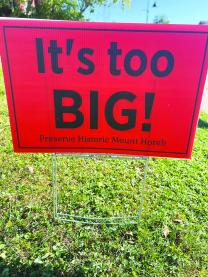
The new revised plan is much prettier than the original. The facades will be pleasant to look at from street level and blend well with downtown Mount Horeb. The remaining problems are best summed up by the grassroots campaign against it: it’s simply too big.
But there are important and identifiable components to this: lack of green space, height, and lack of parking.
The lack of green space I addressed in my last open letter as contributing to possible heat islands. It also makes the city less overtly conforming along Main Street with the Tree City USA signs around town. I mean by that both that it will detract from the overall charm that draws tourists and also detract from the perception of values espoused in Mount Horeb, which attracts tourists and shoppers overall. Including a patio for residents is an improvement over complete lack of outdoor space, but is still not green space.
Height is the sticky place: the architects have significantly redesigned, which is fantastic, so there is no longer the horrifying prominence that would dominate downtown. But it’s still too tall. It’s like the Duluth building built by the same developers: on a scale that is aggressively alien to the rest of Mount Horeb. The scale JG Development thinks is appropriate for Mount Horeb does not appear to align with the scale anyone else thinks is appropriate.
Then there is the parking. Everyone is sick of the parking. I don’t even drive. I’m so sick of the parking conversation. I’m also now on the village Green Team, one of the goals of which is more bike friendliness and helping the village be more friendly to a car-free existence. So, to be clear: I am writing my concerns about the parking as a non-driver who will be able to walk to these businesses.
But it’s 68 parking spots for 63 units plus the businesses. That’s 1.08 parking spots per unit. In densely urban areas, that could be not just adequate but generous for business parking. Imagine someone living upstairs from their workplace, or working somewhere else on Main Street. They wouldn’t need a car and would be able to walk everywhere and eat at our great restaurants. And that’s the thing: they’d pretty much always be eating out because grocery shopping by bike mostly sucks, even with as close as Miller’s is to downtown. Nic’s letter in the agenda includes some really relevant wording: the idea of a captive customer base. Because that’s what they’d be. The urban areas where parking ratios like this are generous are not picturesque village downtowns: they’re dense metro areas that have things Mount Horeb simply doesn’t, like public transit and a wide range of delivery options. The concept presented is that tenant parking will be in-building, but the math ain’t mathing.
Which is the colloquial way of saying: the code that the developers themselves quote in their letter requires:
A minimum of one off-street parking space shall be provided for each bedroom within a commercial apartment.
So, even if we’re not counting studios as having bedrooms, because it’s all one room, leaves us with 13 2 bedroom units and 38 1 bedroom units, for a total of 64 required parking spots. Wow, with that math, their proposed 68 spots actually looks generous.
But the current code minimum is per bedroom with an unwritten addendum of “this is a nice village, so be reasonable,” which gives us 12 studio apartments, 13 2 bedroom apartments, and 38 one bedroom apartments, for 76 minimum parking spaces and a ratio of 1.21. The proposal is for a ratio of 1.08.
Additionally, their letter frames it in a table as dwelling units, when the code is specifically for bedrooms, and the dishonesty is distinctly frustrating. At least they acknowledge later that the reasonable number of parking spaces for their proposed building, if it were anywhere but the downtown area, would be 139. That’s a ratio of 2.21.
And the parking survey addressed non-event days. Which is reasonable except for how hard everyone works on having those event days and attracting people. We invite any out-of-town guests to park in our driveway in the expectation that there will be no parking anywhere else a convenient walking distance from downtown. This could be resolved, potentially, by building a parking garage across the street from the proposed development in the empty lot already owned by JG, which could potentially have an attractive local mural added to the outside, addressing multiple problems at once. Or they could just have fewer units, which would solve more problems.
10 bike parking spaces also seems like a low number when so much is reliant on the ability to attract bike and foot traffic. In fact, if this development were in Madison, 85 bike parking spots would be required. Which is definitely a gap between the proposal and the ideals and development plan the proposal is supposed to conform to.
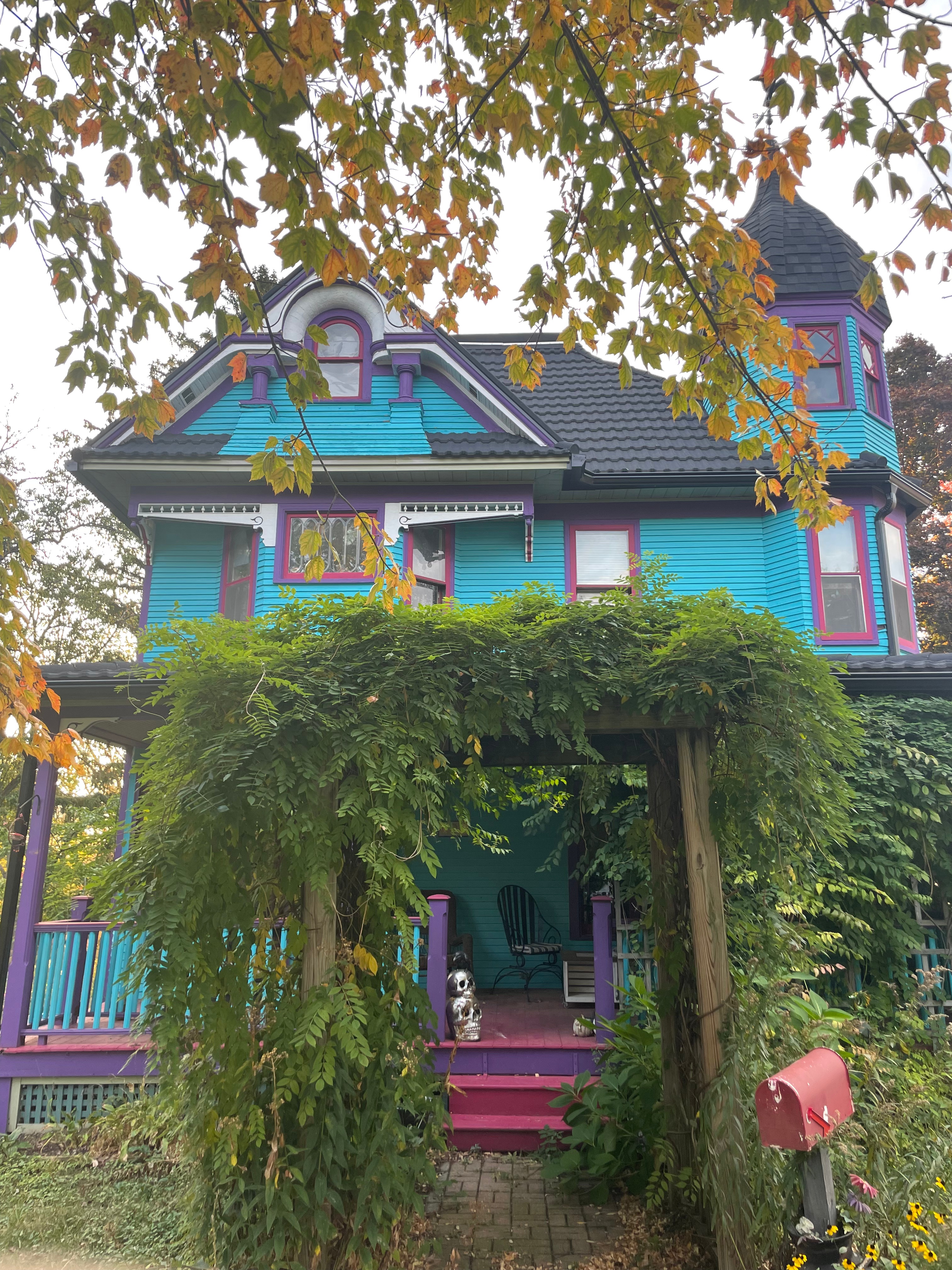
There are additional issues with the way their letter is presented, such as ignoring the complexities of historical designation – my own house is a 1905 traditional Queen Anne style, with colors appropriate to the Painted Lady style of Victorians popular on the West Coast and several original features including many of the windows visible from the Military Ridge Trail. But it doesn’t have a historical designation because it has undergone many renovations, it has newer features like an addition from 1923 and central air and, most crucially, we have not filed for nor requested any kind of historical designation.
But the other issues with the proposal are, of course, secondary to the main problem of the proposed development is, despite being much prettier, still inappropriate for Mount Horeb.
 Eileen Young