Snow Day!

It’s the hardest snow we’ve had all winter here in Victoria. Catching the bus to my new job this morning wasn’t any kind of fun. Yes, new job. Epublishing isn’t paying all the bills yet, so I needed some kind of gainful employment, and have found it in one of the other fields that makes me extremely happy: bicycles.

Which leads me to today’s mini-rant on why buying your child a bicycle from a department store or toy store means you don’t love them.
Bike stores carry children’s bicycles, and that’s where it’s a good idea to get them. First, because a bike store bicycle will be a real brand – the kind that has warranties. The kind that has people who ride bicycles as the ones designing and manufacturing them, which is important, as sometimes people who do not know bicycles will stick the fork (the front bit that holds the wheel) on backwards. That’s dangerous, as it means that, if your kid hits a bump, they may come down hard enough on the shocks that are beneath their downtube and not out front where they should be hard enough to even momentarily stop steering from being possible. Second, bike store bikes are assembled by mechanics, not by you or by someone in the store who may or may not have even ever seen a bicycle before. And no matter how mechanically inclined you are, assembly by a professional helps. Third, your bike store bike will last longer – usually on to the next kid. Bike stores carry fewer sizes, but have the technical know-how to adjust the bikes to fit any kid, and to fit your kid as they grow. The bikes are also of high enough quality that they allow this kind of adjustment. Most bike stores also offer some kind of service deal, that you can bring in the bike once or twice and they’ll fix it as an extension of you buying it there. That keeps your kid safer.
Bike stores also usually offer a wider range of awesome bright-coloured streamers to choose from.
So buy your kid a bike from a bike store. Yeah, it’ll cost more. But that money goes towards buying a bike that will keep them safer and will last longer.
This rant brought to you by affection for children and economies of scale. Promised entry on Japanese literary culture still pending.
Bruce Batchelor at PEAVI

I went to Intrepid Theater tonight to listen to Bruce Batchelor speak to PEAVI – his “musings about books, publishing, and storytelling.”

One of the points he kept bringing up is that we’re in an era of massive, accelerating change in the publishing industry, but also that the publishing industry itself is relatively new. The first paper was around 150 CE, the first codex around 400 CE, movable type and the subsequent European rise in literacy not until 1650 CE (interestingly, Japan had about an 80% literacy rate in the early 1600s, significantly earlier than Europe. More on their consistently bounding ahead of us on literary matters in a subsequent post).
It’s a tradition nearly as old as publishing houses themselves to fear the end of printed books and bookstores going bankrupt. Publishing houses have only been around since the 1800s, according to Bruce. Before that, it was the author as entrepreneur, which is a lot of what we’re headed back to with the independent publishing options available today. Another interesting echo is the paperback vending machines available at train stations and the like in the 1930s, which smack of limited Espresso machines.
Technology continues to proliferate and an ever-accelerating rate, threatening to leave some of us out of our depth. The rule of thumb Bruce uses is to relate new technology to what would exist in a tribal situation, like the rise of audiobooks as compared to traditional minstrels and storytellers. It’s an interesting comparison to think about, and an interesting approach to the complicated and amazing new world the publishing industry is becoming.

It’s a Complicated New World

Having just read the Globe and Mail article bashing freelance editors, I felt the need to respond.

The publishing industry is changing, and I live in the Mecca of indie publishing. The idea of Editor as arbiter or taste is a limited one, a little old-fashioned. Editors exist to make written work better.
That can take a variety of forms, from structural editing to proofreading. And not just for what we typically think of – a novel going through traditional press, to be issued in dead tree format. Academic papers require people to look them over to make sure a coherent point is being made, proposals for books require proofing, limited runs of guidebooks for use by museum staff at a tiny museum need to be edited for clarity and flow. Then we get into the indies: people eschewing traditional publishing in favor of epublishing and print on demand and retaining control over the entire process of their book. They need editors, too, ones who will work with them to make sure they walk away, happily, with the best their book can be.
I like to think I help with that, as well as aiding in epublishing. Like most freelancers, I’m willing to provide samples: I will go over the first five pages of your manuscript for no charge, to see if we can work together.

Navigating The Ebook Jungle Now On Amazon

It took a little longer than expected, but Navigating The Ebook Jungle is now available on Amazon for download to your Kindle.

An interesting aspect of putting it up on Amazon is that, to keep the price point the same, I had to lower the royalties I receive to 35%. The lowest price at which you can receive their other royalty rate, 70%, is $2.99. Probably irrelevant for most people, as almost everyone will charge more for ebooks than the $1.99 Navigating The Ebook Jungle is priced at, but interesting from the technical aspect.
I’m already considering ways to expand on the book; with a lot more research on pricing.

Navigating The Ebook Jungle

So, this is where I usually put my writeup of the most recent Victoria Writers’ Society general meeting, as it’s the first Wednesday of the month.

And I get to do that tonight, but tonight it is more awesome than usual, as I was one of a panel of speakers on how to get your book out there, with Melody Poirier and Iryna Spica. Since I knew I wasn’t going to be able to cover in depth everything about my area of expertise, I put together an ebook about it.

Visual Novel

A friend of mine recently introduced me to visual novels, a sort of hybrid video game and storytelling medium, in the form of the game Ever 17, a psychological horror visual novel.

When I first started describing the game I was playing to a friend of mine unfamiliar with the term ‘visual novel,’ he responded with, “Oh, like a dating sim but without the porn?”

Well, yes. But for those of us less fluent with teenage-male-oriented computer games from Japan than my teenage, male, frequently video- and computer-game playing friend, visual novels are more like a shiny, illustrated Choose Your Own Adventure novel.
Exploring the different options takes you through the story, with the things you look at and the people you interact with popping up in front of you in still frames that change every time you click over to the next line or instance. It’s an interesting experience to play, and an interesting medium in which to tell a story and explore a world.

The Bluff Detector Launch

Tonight I went to the launch of The Bluff Detector by W. Thomson Martin at the Solstice Cafe. It was lovely – Thom has a melodious voice with more than a hint of his Northern Irish accent, and started us off with the slyly whimsical tale of the first time he was accused of irreverence. The rest of the reading showcased the thoughtfulness and quiet joy in life that infuses a lot of the rest of the book.

A highlight of the reading for me, aside from picking up a copy and getting it signed, was speaking to his publisher, Bruce Batchelor of Agio Publishing House. Before Agio, Bruce headed up Trafford Publishing and helped launch print-on-demand printing as a viable route. He’s going to be speaking to PEAVI in February.

Author Interview: Laura Bradford


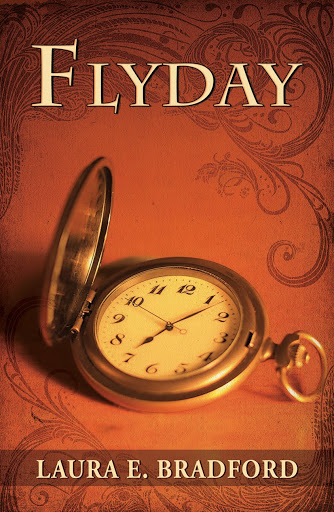
I just finished an interview with Laura Bradford, author of the upcoming novel Flyday.

EY: What’s Flyday about?
LB: It’s set in the future, about a journalist who gets pulled into a murder investigation when his fiancee’s brother is the accused. The journalist finds himself visited by a time traveler who brings new insight into the case, and things just take off from there.
EY: What inspired you to write it?
LB: Well, I’ve been writing since I was very young, but I decided to write a novel a few years back and this was the idea that took off. It mixes a lot of my interests–science fiction, music journalism, adventure stories, etc. The characters sort of captivated me, and I wanted to see where their story went.
EY: Is Flyday going to have a sequel?
LB: Yes, I have a whole series planned out. I’m editing the second book now.
EY: That’s exciting! When do you think that will be coming out?
LB: Right now I’m not sure. It still has a long way to go, and I’m coming up on my last semester of school.
EY: Quite an accomplishment, to have managed to put Flyday out while going to school. What made you decide to self-publish?
LB: I sent queries to agents, and the answer was a unanimous “Interesting, but not for us.” But when I showed it to people, they seemed to love it, and I had a lot of requests for copies to pass around–more requests than I could fill. Eventually I saw that e-publishing was taking off, and I decided that putting it out there was much better than letting it sit on my hard drive, especially once I started working on the rest of the series.
EY: Will you be making it available in print as well as electronic versions?
LB: Eventually, yes.
EY: What channels are you using to sell it as an ebook?
LB: I put it on Smashwords, and right now I’m waiting for it to go up on Amazon and Barnes & Noble.
EY: Is there anything else you’d like to say?
LB: Mainly that I hope people enjoy the novel. E-publishing has been a really interesting experience for me, and I’m glad to finally be getting the book out there. My blog is also http://lauraebradford.blogspot.com if anyone wants updates about the project.
EY: Okay. Thank you for being my first interviewee for Authors’ Refuge, and I wish you luck with Flyday!

The making of a book

I just finished a meeting with Michale Cnudde, the gentleman whose novel I’ve been editing. I’m done editing! I’ve handed the all-important flash drive over to him to approve changes before we start formatting. Then I format it for epublishing while Tristan Tinder does the cover and formats it for print through Island Blue.

It’s fascinating and fun to be able to help put it together.

Writing in the new year

On December 4th, I published a collaborative novella that I’d done with my friend Mason on Feedbooks.com under a Creative Commons license. I had no expectations about readership: I thought it’d be really cool if we got a hundred downloads by the end of the year.

We got that in two days, and currently have 1392 downloads. It’s very neat, to have that many people have read my – well, our, but this blog is all about me, so the pronoun stands – writing, and it’s a fantastic impetus to write more.
Earlier this week, the Victoria Writers’ Society had its Annual General Meeting, and managed to elect most of a new executive: I’m still in charge of the website, our wonderful treasurer Laura is still in charge of all the money, and Edeana is still managing all of our critique groups and the summer writing contest. The presidency is sadly vacant, though, leading to lists of candidates for us to approach.
Our new executive is a different landscape and tone than the last one, and will prove interesting to work with. The writing community in Victoria is a huge part of how I approach writing, and takes up a large portion of the time I can allot to writing. It’s fun, and an adventure.