I have written research papers, technical documentation, and fiction – and edited the same. This is an overview of publicly available content I have created or been involved in by general category rather than theme or medium and doesn’t include reports written anonymously.
Credits
Editor for Wisconsin Gardens, 2026-
Group credit where I served as QA coordinator for the project at large: Methods of Assessing Duplication of Benefits with Patient Care Revenue: As Applied by the Federal Emergency Management Agency to Health Care Providers’ Public Assistance Claims During the COVID-19 Emergency. Homeland Security Operational Analysis Center operated by the RAND Corporation, 2024. https://www.rand.org/pubs/research_reports/RRA3326-1.html.
Thanked for research assistance: Roberts, Patrick S., The Emergency Management Institute at 70: From Civil Defense to Emergency Management in an Education and Training Institution. Homeland Security Operational Analysis Center operated by the RAND Corporation, 2023. https://www.rand.org/pubs/research_reports/RRA1523-2.html. Also available in print form.
Editor for Biden School Journal of Public Policy (previously New Visions in Public Affairs), 2018-2020
Third Place in UW-Whitewater Superior Student Writing contest in the Spring 2015 Research (non-Literature) category
Anything Goes Writing Contest multiple award winner
Editor in Chief of Island Writer January 2011 to May 2012
Publications
Herman, Rebecca, Phoebe Rose Levine, Peggy Wilcox, Eileen Young, Jin Kim, and Patrick S. Roberts, Emergency Management Certificate Programs: Current Picture and Future Possibilities for the National Disaster and Emergency Management University. Homeland Security Operational Analysis Center operated by the RAND Corporation, 2025. https://www.rand.org/pubs/research_reports/RRA3025-6.html. Also available in print form.
Young, E. (2024). Where the Smoke was Coming From: Risk Assessment, Social Ties, and Expanding Roles in the Evacuation of the Beverly Hills Supper Club Fire. Dissertation
Young, E. (2022). Democratizing course access. In Monica Sanders (Ed.), Creating Inclusive and Engaging Online Courses (pp. 11-23). Edward Elgar Publishing. https://doi.org/10.4337/9781800888883
Young, E., & Aguirre, B. (2020). PrioritEvac: An agent-based model (ABM) for examining social factors of building fire evacuation. Information Systems Frontiers, https://doi.org/10.1007/s10796-020-10074-9. You can also read the paper here.
Young, E. (2019). Prioritevac, an adaptive model for evacuation: Agent based simulation of the station nightclub fire (M.S.). Available from ProQuest Dissertations & Theses A&I. (2318149785). Full text
Young, E. (2018). The role of public libraries in disasters. New Visions for Public Affairs, 10, 31-38. https://cpb-us-w2.wpmucdn.com/sites.udel.edu/dist/a/7158/files/2018/04/NVPA-Volume-10-27fekmi.pdf .
Presentations
Some of the presentations I’ve given have been recorded:
2022 SFPE
I was invited to speak to a meeting of Northern California – Nevada Society of Fire Protection Engineers.
2019 Natural Hazards Workshop Researchers meeting
I was delighted to be presenting on the panel of Hazards Research by New Professionals.
You’ll note that this is an extremely simple presentation, with extra cat pictures. This is because there’s evidence (1, 2) that duplicating text and audio information is unhelpful at best. But presentations are still the industry standard, accessible in different ways, and provide a quick point of reference for people arriving late or leaving early. Since they are very simple slides, and my roommate’s cats are very cute, they are there for visual interest.
I’ve made multiple presentations about my Station fire research – two of them were taped and are viewable on my Research page. That was also the subject of my Master’s thesis, and multiple other papers are currently under consideration, so I won’t go into extensive detail here.
My newer research, and the focus of this talk, is on the Beverly Hills Supper Club Fire in Kansas in 1972. It adds new complexity to the way I’m studying fires, based on several factors, some of which inform wildly different parts of the approach.
- Multi-story building (programming)
- Now working from an extensive paper dataset rather than a csv
- Aggregating the data
- Making judgement calls about group identification
- Matching evacuation maps with surveys and police statements
- Fire burned a much longer time before it was noticed, and there were more internal walls, which in turn impacts several factors
- Warnings and alarm
- Evacuation speed
I do not yet have a computer model of this evacuation, but it will come eventually. So far, the greatest insights have come from reading the statements and surveys, where people discussed why and how and when they did things in some detail. Particularly, people’s awareness of the fire as a hazard to be taken seriously has been thrown into sharp relief. There is a persistent thread of gender as it impacts hazard awareness throughout the literature, and this is borne out in some cases, such as all of the female musicians in the Cabaret Room packing up and leaving as soon as they were notified, while none of the male musicians did, but there are additional factors showing up, as well.
The way the warning worked in that particular room is there was a comedy act ongoing while people ate dinner, and a busboy came in and got up on stage to announce that the building was on fire. Initially, some people considered this as part of the comedy act, which definitely influenced how seriously people took the warning.
But, before he got on stage, the same busboy – a young man, generally considered part of a demographic that is less risk-averse – alerted the head waitress of that room – a somewhat older adult woman, generally considered part of a demographic that is more risk-averse – that there was a fire. She dismissed him, and dismissed concerns about the fire. This raises questions that are harder to isolate on a broader scale over how social status specifically – as opposed to gender generally – influence risk perception.
There are also interesting pools of information in how employees acted. Specifically, many identified the people at their tables as their people and proceeded to shepherd them out, while some employees who were in the kitchen or in less customer-facing positions were more oriented towards the fire or other employees.
These are preliminary findings, of course, because in March we all went home and pivoted to COVID-19 research, and since these boxes are one of a kind irreplaceable data they’ve been in lockdown ever since. I miss them.
2019 Hazards poster
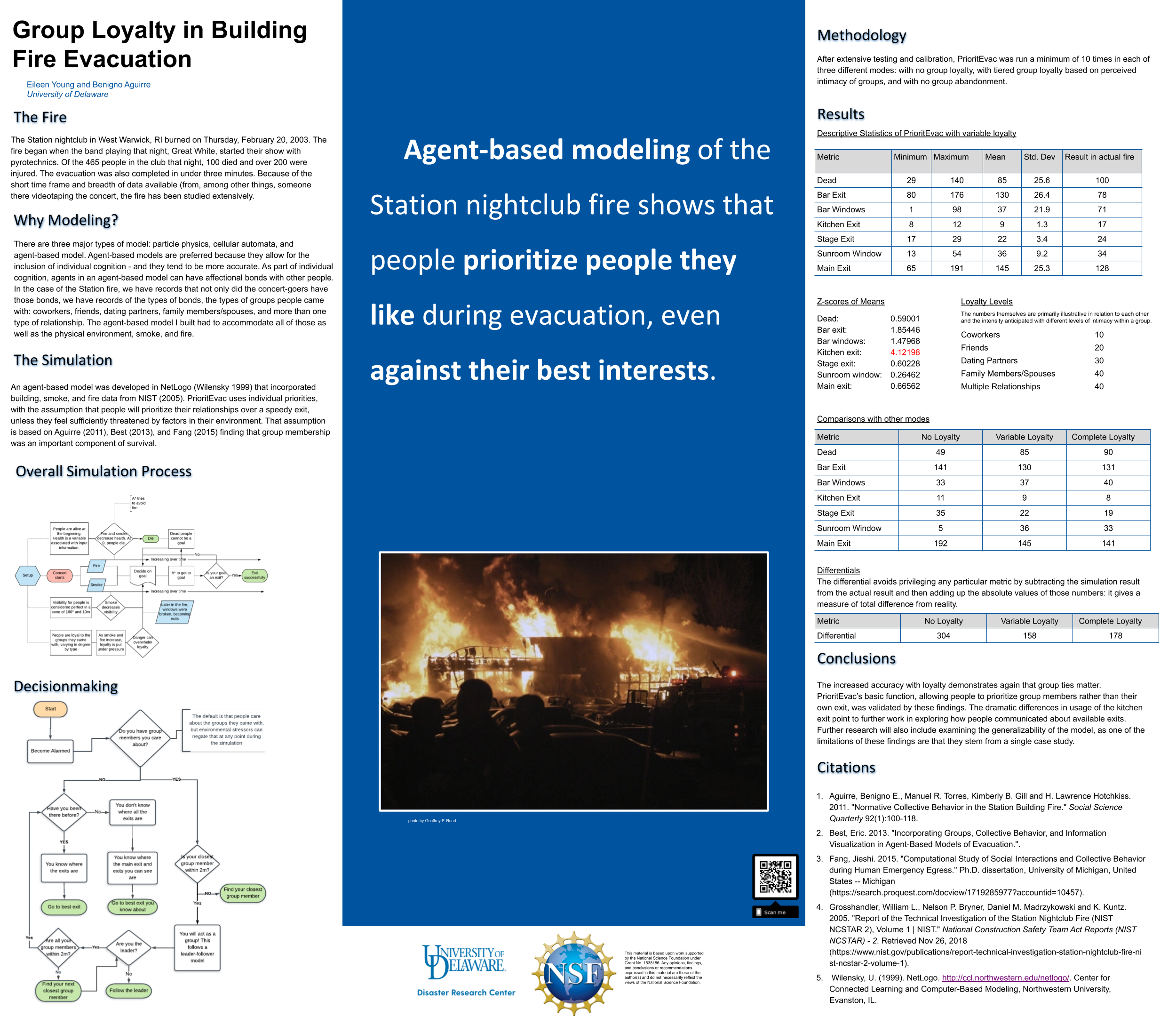
The text from the poster is also available in plaintext. My thesis has more details on methodology and implications.
2019 SFAA Presentation
This presentation was completely written ahead of time because I was presenting the results of work with my mentor and advisor, who wasn’t able to attend.
Eileen Young & Benigno Aguirre
Thank you all for being here this afternoon. My co-author, Dr. Ben Aguirre, couldn’t be here today.
Since we’re talking about resilience as a concept, as a term, as a kind of language of its own, I’m going to start with the overall project I’m working on to give you the background for where the ideas of resilience I’m working with come from, for my personal etymology, then tell you about our specific research, and then some of the ways it interplays with other concepts of resilience.
The overall project we’re on is called Interdependencies in Community Resilience, abbreviated ICoR, and is funded by the NSF. It’s primarily based out of the University of Michigan engineering school, and as such is very physically based. There are people building computer simulators that model hurricane impacts on cities, that model earthquakes’ impacts on buildings, that go into life cycle analysis of building materials that could be impacted by a natural hazard, and those are the primary approaches at play in the project. There’s also an overarching simulation framework set up so that we’re modeling a hypothetical city in which these hazards can all happen and influence each other. Since hazards aren’t necessarily straightforward and singular, this framework lets different hazards interact more the way they would if they occurred in the real world. The idea is that with an accurate model of a hypothetical city we could predict what would happen to the physical infrastructure of any given actual city and then build better buildings and, overall, build better cities that would be resilient to these different hazards that we’ve modeled in their component parts. My part of that is that of modeling social factors as they relate to the whole, which right now is focused on group loyalty in evacuation from fire. I am bringing the social science to bear on everything else that’s going on and that’s important because social factors have been shown to be really important in any kind of evacuation. Some of the earlier research that pointed to this was Simes’ work in the 80s on affiliative behavior in evacuation, but more recently there’s been a lot of work done looking at the Station nightclub fire in Warwick Rhode Island in 2003.
For those of you unfamiliar with the fire: the rock band, Great White, that was playing the club that night started their show with pyrotechnics. The pyrotechnics ignited the foam behind and around the stage, and the fire spread rapidly. The 465 people in the building, over the occupancy limit at the time of 404. That number, though, is somewhat questionable, as a few years previously the maximum occupancy was assessed as 317. The exact whys of the number change are beside the point: there were more people than there should have been, and it was very crowded. The crowd was made up of concert-goers and bar employees as well as a local radio station and a cameraman covering the show who noticed a problem 24 seconds after the pyrotechnics started, when the fire stopped being plausibly still pyrotechnics, and they started evacuating at about 30 seconds. The fire spread rapidly, partly due to the several hundred square feet of highly flammable egg-crate packing foam that covered the wall behind the band. After about a minute and a half people started breaking windows to augment the four exits doors – only three of which were apparent to non-employees. After three minutes, the evacuation was over.
Because of several of the factors involved in the fire, not least among them the recordings available and the extensive interviews conducted after the fire, it has been studied and modeled extensively, from the earliest models by Grosshandler et al (2005) that were in the NIST technical report on the fire to Valette et al (2018) which incorporated emotions and social skills in the model. The expansive dataset available as a result of secondary study of the official reports means that it’s both straightforward to enter accurate starting data and possible to validate results based on a number of metrics. We have accounts of who came together, which forms a map of the social connections between people who were there. We also have counts for how many people used each exit, as well as details that provide further nuance, like that the bouncer initially turned people away from using the stage ext door. All of this data is a result of substantial qualitative research – hundreds of hours of interviews and coding the data that come from those interviews and other supporting documentation like photos, video, and coroner’s reports. So, for the agent-based model that we’re doing, as well as agent-based modeling in general, we get to take that qualitative data and the theory that came from it and operationalize it such that we can assign numbers to it.
One of the primary things that agent-based modeling can contribute to the overall scientific conversation is pointing out where we have missing variables in our ontology of a situation or phenomenon. That’s the reason that external validation of models is so important, using those numbers we assign. It’s both why the Station Fire has been revisited so many times and why the dataset available for this fire is so important. Agent-based modeling is about operationalizing how we think people work, at whatever unit of analysis is most relevant to the scenario being explored. And if a model isn’t turning out results reasonably accurate to the situation being explored, it’s worth exploring the assumptions that shaped the model. ‘Reasonably accurate’ because modeling by its nature doesn’t account well for dramatic outliers. But looking at the overall results, divergence from observed reality can point to something foundational that’s underexplored. Fire evacuation research is home to excellent examples. Some models started with the assumption that people behave rationally, like Spearpoint’s (2012) network model of the Station Nightclub fire that had people use the closest exit. That model had zero casualties, as opposed to the hundred from the actual fire, so obviously it’s missing something in how people behave. This is one of the reasons that panic and the lack thereof is a recurrent conversation (Aguirre et al. 2011a; Johnson 1987; Johnson, Feinberg, and Johnston 1994; Torres 2010), because panic is an easy catchall amongst non-social scientists for irrational or poorly understood social behavior in an emergency situation. But since we have widely dismissed panic, and agent-based models of perfectly rational people are shown to be inaccurate, the models very clearly point out where we’re missing information as a field. Some element or elements of individual cognition is responsible for why people don’t behave perfectly rationally, and because agent-based models operate at that level, they highlight a specific and concrete gap.
For the specific research that we’re doing, group loyalty is the linchpin that we’re examining as an explanation for the behavior that goes beyond the rational. Sime (1985) found that people move towards the familiar, and that’s something we’re building on, taking it further to ask: how strong is that impetus? Do people ever decide a situation is so dangerous that they abandon affiliation for self-preservation? Aguirre et al found that distance from the rest of the group at the beginning of the fire was a primary determinant of survival (2011), and that stronger group ties correlated with more accurate predictive abilities in models: that these social and group factors matter specifically in this fire (2011b), so this current model is a matter of refining and quantifying an understanding of how these social factors come together.
Modeling is inherently postdictive: that is, it tells us what has already happened, and some of why. It doesn’t necessarily tell us what to do: it’s the fuzzy edges in an overarching project that is focused on solid physical practicality. For most of the ICoR project, resilience is a matter of buildings that don’t break, of mitigation such that a hazard can pass without ever becoming a disaster. In some of the social science around resilience, it is a community scale, a matter of how quickly a community can return to normal operation after an incident. But what is resilience in fire evacuation? Is it a building that doesn’t burn, an evacuation plan that gets everyone out safely, fire suppression measures, or grief counseling in the aftermath?
Our research isn’t trying to answer that question, though I will admit to quiet uneasiness at the last as something to be embraced. Our research isn’t even inherently about evacuation planning, even though it’s about evacuation, because the Station nightclub was over 100 people over reasonable capacity at the start of the fire and 100 people died, pointing to at least one risk reduction measure that was working as designed, just ignored in practice. Our research is primarily about understanding. That understanding can be used to potentially develop better buildings. As it is, buildings are designed and engineered with clearance rates – that is, the fastest rate at which people can be cleared from the building in an evacuation – as a concern. But better understanding how people behave and prioritize in an evacuation can help shift that consideration from can to will: how fast will people likely clear a building, considering their social ties and emotional priorities? Understanding allows for additional dimensions to be added to resilience, such as trying to build a building that doesn’t burn but can also be evacuated safely if it does.
Better buildings are a small building block, on the scale of pan-national community resilience, but one that can serve as an underpinning to build upon in pursuit of other types of resilience. And beyond the physical, a better understanding of how people are likely to evacuate can lead to evacuation plans that are more congruent with how people prefer to behave. The final piece to come out of this kind of agent-based modeling of human behavior in evacuations is that it might contribute to more precise occupancy limits. Though in the case of the Station fire, the building was significantly over the occupancy limits dictated by the local fire marshall. That in itself is a further argument for physical architecture that conforms more to what social science can tell us about human behavior, since no matter how much we understand people, it’s going to be harder to have them change on the fundamental level that dictates that they care about other people than to just build in an extra emergency exit.
And people do care. Since I’ve talked about the ability of agent-based modeling to provide numbers but not provided any of my own, here they are: in some of the preliminary results that have come in, accuracy dropped from 72% to 44% when I set it so that people would overwhelmingly prioritize their own survival and easily abandon their groups. When I extrapolated from that, determining that loyalty should be higher than its initial setpoint, accuracy jumped to 89%. Social science is integral to any comprehensive approach to resilience.
References
Aguirre, B. E., Manuel R. Torres, Kimberly B. Gill and H. Lawrence Hotchkiss. 2011a. “Normative Collective Behavior in the Station Building Fire.” Social Science Quarterly 92(1):100-118 (https://www.jstor.org/stable/42956476). doi: 10.1111/j.1540-6237.2011.00759.x.
Aguirre, B. E., Sherif El-Tawil, Eric Best, Kimberly B. Gill and Vladimir Fedorov. 2011b. “Contributions of Social Science to Agent-Based Models of Building Evacuation.” Contemporary Social Science 6(3):415-432 (http://www.tandfonline.com/doi/abs/10.1080/21582041.2011.609380). doi: 10.1080/21582041.2011.609380.
Grosshandler, William L., Nelson P. Bryner, Daniel M. Madrzykowski and K. Kuntz. 2005. “Report of the Technical Investigation of the Station Nightclub Fire (NIST NCSTAR 2), Volume 1 | NIST.” National Construction Safety Team Act Reports (NIST NCSTAR) – 2. Retrieved Nov 26, 2018 (https://www.nist.gov/publications/report-technical-investigation-station-nightclub-fire-nist-ncstar-2-volume-1).
Johnson, Norris R. 1987. “Panic at “the Who Concert Stampede”: An Empirical Assessment.” Social Problems 34(4):362-373. doi: 10.2307/800813.
Johnson, Norris R., William E. Feinberg and Drue M. Johnston. 1994. “Microstructure and Panic: The Impact of Social Bonds on Individual Action in Collective Flight from the Beverly Hills Supper Club Fire.” Disasters, Collective Behavior and Social Organizations:168-189.
Smith, R. A. 1995. “Density, Velocity and Flow Relationships for Closely Packed Crowds.” Safety Science 18(4):321-327 (https://www.sciencedirect.com/science/article/pii/0925753594000514). doi: 10.1016/0925-7535(94)00051-4.
Spearpoint, M. 2012. “Network Modeling of the Station Nightclub Fire Evacuation.” Journal of Fire Protection Engineering 22(3):157-181. doi: 10.1177/1042391512447044.
Torres, Manuel R. 2010. “Every man for himself? : Testing multiple conceptual approaches of emergency egress on building evacuation during a fire.”.
Valette, Marion, Benoit Gaudou, Dominique Longin and Patrick Taillandier. 2018/10/29. “Modeling a Real-Case Situation of Egress using BDI Agents with Emotions and Social Skills.” PRIMA 2018: Principles and Practice of Multi-Agent Systems:3-18. Retrieved Jan 16, 2019 (https://link-springer-com.udel.idm.oclc.org/chapter/10.1007/978-3-030-03098-8_1). doi: 10.1007/978-3-030-03098-8_1.
Zheng, Xiaoping, and Yuan Cheng. 2011. “Modeling Cooperative and Competitive Behaviors in Emergency Evacuation: A Game-Theoretical Approach.”Computers and Mathematics with Applications62(12):4627-4634 (https://www.sciencedirect.com/science/article/pii/S0898122111009126). doi: 10.1016/j.camwa.2011.10.048.
PyGotham 2018 Presentation
2018 New Visions in Public Affairs
A handout to accompany this presentation is available here.
The full paper is in the tenth anniversary edition of New Visions for Public Affairs.
Projects elsewhere:
 Eileen Young