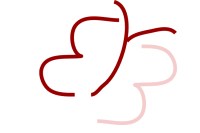
The launch for the Summer 2010 edition of Island Writer was this last Wednesday. It was my first launch; I was on vacation during the last one, and it was also my first launch as a member of the editorial staff. I was and am the editorial assistant for the magazine, and it’s a tremendous learning experience for me, seeing exactly what goes into a publication. I was also lucky enough with this issue to have two illustrations included. At the launch I got the meet the author of one of the stories I illustrated, Judith Mackay, and that was wonderful, to actually meet the person whose work I worked with. I hadn’t even spoken to her before that, except in form letters sent in my capacity as editorial assistant.
This issue was also the last issue for the editor in chief I worked with, Stacey Curtis. She’s spent the last several issues as the editor, and is moving on to other projects. She was wonderful to work with; creative, open to input on the technical side (we used Google Docs for some stages, which was a great and easy way to get everyone the files), and patient of my inevitable mistakes.
I met several of the new editorial staff at the launch, as well, and am looking forward to working with them on the next issue, coming out in December.
Epublishing and Publishing Companies
Went to a very interesting talk by the estimable Ruth Linka of Touchwood Editions and Brindle and Glass about the effects of ebooks on the publishing industry. This was a couple of weeks ago, but it took me some time to both process the information in her very informational talk and examine my own feelings about it.
It’s a complicated subject, the role of ebooks in the world of publishing. I read a lot of ebooks, and a lot of books released free online under Creative Commons licensing. Ruth mentioned something about the new “Cult of Free” that I wish I’d written down, about how my generation very much believes in free things, and how that’s not exactly harmonious with the publishing industry. More on that later.
Ruth also said very definitively that ebooks are not a trend. They are here to stay. The difficulty lies in that there are easily two dozen separate and unique file formats that someone at a publishing house has to convert them to.
There is a movement, of course, towards some sense of uniformity. And PDF, of course, never goes out of style, though it’s less than ideal for several platforms. And a different ISBN is needed for each individual e-release. All of which takes man-hours, which contribute to the price of a book. This leaves aside the fact that the cost of editing remains the same, and one of the biggest components of book price. There is a general feeling that ebooks should be cheaper than paper because there are no associated printing, storage, or delivery costs, but those are much smaller factors for small printers. For large distributions, like that of bestsellers (Harry Potter, Twilight, or anything else people dress up and wait for hours in the rain for the release of), editing and other man-hour costs become a much smaller part of the cost, which allows them to keep the cost of ebooks low. Given the low cost set as the standard for ebooks, it is harder for small publishers to keep up with low prices.
On the other hand, ebooks are ideal for self-publishers. The cost of a print run can be hugely intimidating for an individual, but ebooks have, wonderfully, no printing costs. With no initial capital outlay (other than an editor, of course, and a graphic designer), epublishing allows many more authors to get their work out there. There is still, of course, the attendant hard work and devoted marketing required of any self-publication, but it makes it more accessible. But part of that accessibility is that the market for ebooks is flooded, and not everyone is willing to pay for an ebook by an unknown author, especially a novel, when there are novels available for free under Creative Commons and public domain. Novels by noted authors, too, including Cory Doctorow.
Part of that is my own devotion to the Cult of Free (backed up, you’ll note, by there being no price tag on any of the stories I have up). But it will be interesting to see how the Cult of Free and other market forces affect the future of the ebook and the publishing industry.
Speculative Fiction
A couple of weeks ago, the Victoria Writer’s Society was able to invite Kim Bannerman to speak to us about Speculative Fiction and about her own fiction, a very Speculative Fiction series of novels about a family of werewolves. Because of her anthropological background, a lot of it was about the evolution of Spec Fic, both as a term and as a field. When the term was first coined, and when it was used widely by Heinlein, the term was interchangeable with Science Fiction, and specifically excluded fantasy. But genre evolution and label defiance being what they are, Speculative Fiction now refers to everything that happens in a reality different from our own. That covers horror, fantasy, sci-fi, superheroes, steampunk, cyberpunk, post-apocalyptic dystopias, and magical realism. Pretty broad spectrum, there. But in some ways it’s necessary, with authors like Richard Kadrey writing things like Metrophage one year, with Los Angeles futuristic and technology-laden, and then for his next book Butcher Bird, which takes you into Hell. With this variety, books that fit into science fiction and fantasy and dystopian post-apocalypse fiction, he’s hard to describe as anything other than a Speculative Fiction author.
Collaborative Writing
Subtitle for this would be “Legitimizing the geeky things I did in high school.”
Collaborative writing spans many things, from the group of elders at a local church who work on their memoirs together to the group of romance authors who beta read each others’ work to the online role-plays popular among many high school and college age people.
It’s a great tool; collaboration with others encourages you to write more, both in terms of wanting to keep up with other people’s output and encouragement in that other people are reading your work. And the immediate feedback helps you improve as a writer.
One of my current projects is collaborative; I’m writing a story with a friend of mine. He loves the world-building side, and I really like storytelling, so we work well together. I do a lot of the writing, posing him questions as we go along to be sure it’s a coherent world. He goes over what I’ve written, tweaking some things that stand out and adding more to the story, especially focusing on fleshing out the character that is primarily his. And, most helpfully and most fun, we get to discuss it. The story becomes that much more concrete with someone to discuss it with.
That is one of the perks of a critique group, another form of collaborative writing. You may not, and probably don’t, write in each other’s stories the way I and my friend do, but the feedback helps you shape the edits, and having a group to discuss it with helps make the story more real; it isn’t just something you are doing, it is real, and other people are reading it. I find that for me, knowing that I have an audience helps me remember to fully articulate my points in my writing.
A role-play is an even more involved collaboration; rather than it being one person’s story being examined, or a project with an agreed-upon outline, most are free-form, with the plot developing as it progresses. In general, every writer writes from the point of view of their one or more characters, and have little or no understanding of the other characters except as they are presented in the role-play by the other writers involved. And the number of contributing writers can vary from two to over thirty, such as in some of the more long-running ones on the popular site LiveJournal.
The image of writer as a solitary creature chained to typewriter, emerging only for coffee, doesn’t necessarily hold true. There have always been support networks, artistic enclaves, to further a creative spirit. Now there are more, more readily accessible, and more tailored. The friend I am collaborating with lives 2000 miles away; the memoir group at the local church all meet in person, and all have similar interests. If you are interested in a support network or a more collaborative sort of collaborative writing, a quick google search will most likely find you something that fits your needs.
Networking
A friend of mine just expressed confusion on the usefulness of networking. It can be a foreign concept if one doesn’t live in the world of social media, which was surprising to me, since I’ve lived in social media for the last few years. Social media is networking applied on a wider scale; you’re making contacts, but with more people. It is one of the most important aspects of business, but it doesn’t have to be scary and insurmountable to get into. Even a Twitter account can let you follow companies relevant to your industry without much time commitment or technical know-how.
Online Security
Reading articles about Google, particularly Buzz and the problems blogger Harriet Jacobs faced, brings home a lot of the attitude shift that has come with a lot of new internet technology. At the beginning of the noughties, the internet was seen as a foggy area full of malicious predators, and one was supposed to never, ever share information about one’s real life – address, phone number, and real name were all taboo. Then came social networking; we found our friends on sites like Facebook and Myspace, and now we search for new business contacts that way. And on our profiles, like the Google profile, there are blanks just begging to be filled with all of our email accounts and IM accounts and address. And if you have the Android operating system on your phone, you can have it tag your updates with your exact GPS.
If one has a network of only close friends, family, and business contacts, that might not be such a bad idea, but when one is using the internet for prospecting business contacts, or has a wider social network, it becomes an issue of balance. You want new prospective clients to be able to contact you, but not to know where you live. I think I’ve found what works for me; my city and my email are everywhere, my age on some things, and my real name, while my offline contact information is kept private. But my business is conducted largely online or in an office, where it’s the office and not my personal information being used as contact. Business-people in different fields, especially writing and editing, where marketing of yourself matters so much, need to find their own balance, and one that takes into account every tool they put out there. If you want to be anonymous, putting your full name and address into your gmail (and in turn your Google profile), might not be the route for you, whereas if you want to be highly public, you don’t want different nicknames and out-of-date information on every account.
So check your settings, and google yourself so you find what other people can find about you. Make sure it’s what you want them to be able to find. I’m off to check my Facebook privacy settings.
Google Fiber
Google is continuing to revolutionize the internet with their latest project, Google Fiber, blogged about here. Accessible broadband is an important step forward for any country; the old ideology of the ‘information superhighway;’ information about everything available to everyone, only holds true if everyone has access. But, with growing access, including projects like this, it becomes more and more important for a business to have an internet presence.
The Many Wonders of Social Media
Today I got to give a mini-tutorial on Twitter at my workplace, and talk about the benefits of it for a business. It’s exciting to have it branching out in different ways; this started as a simple question of publicity for an upcoming event.
Twitter really is a necessity for any business or business-person; there are a growing number of businesses advertising positions on Twitter, sometimes exclusively. And with news sites, retweets, and the ability to sort into timelines, it is a growing Internet hub.
Accelerando
Mid-way through reading Accelerando by Charles Stross. It’s an interesting take on the dot-com boom and what might have happened if it didn’t bust. It’s also an interesting look at evolution; technical modifications allowing us to continue to advance and adapt. Our ability to adapt is key to staying on top. That, and those are really awesome glasses.
Social Media Packaging
It’s quite a paradigm shift, reading about social media in articles like this one. I’ve been on networking sites of various kinds since early in high school; at that point, we were the young end of the target audience, and it was a good way to find and make friends with and procrastinate on homework by talking to people all around the world with similar interests. Now, as I’m becoming a young professional, and looking for ways to reach my target audience, I’m encountering all of this information and excitement about the uses of social media for professional networking. And I realized; I can do this. I had to be kicked off Facebook late at night in high school, and I had a Twitter to follow some of my favorite comic artists. But the approach was new, the view of it as a real professional tool and not just a way to keep in touch with friends half way around the globe. It really is an exciting thing, altering my views and approaches to keep up with this wave.
 Eileen Young